Wednesday, May 11, 2011
Tuesday, May 10, 2011
Cow Pedicures
Lariat and LaFonda's hooves were getting pretty long after the long winter of not walking around the pasture much. If their hooves grow too long, it can be uncomfortable for cows to walk and they can even break off right down to the flesh - very painful. I got the name of cattle hoof trimmer Bob Hanson from our dairy farmer neighbor. Bob happened to be working on a nearby dairy farm today and was able to come here afterwards.
Bob pulls his complete cow manicure parlor behind his truck, so all we had to do was plug it into our clothes dryer outlet and convince each cow to walk into the chute--a challenge, but not too difficult with my secret weapon: cow cookies. LaFonda's horns were a bit tricky, but Bob knew what he was doing. And LaFonda didn't.
Two belts support the cow from underneath so she can't kick or move around and a strap holds each foot in place for trimming. Coincidentally, I scheduled the hoof trim for the perfect time, right after calving.
It's not the most dignified position for a cow.
Bob has had his hoof-trimming business for 30 years. He said in his younger days he used to do 60 cows a day; now he usually does 40. Besides trimming the hooves, he checks for foot sores or hairy warts and treats any problems. My cows didn't have any problems but LaFonda did have a small stick stuck in one hoof that could have caused future problems if not removed.
After LaFonda, it was Lariat's turn. She was pretty suspicious, but food hound that she is, she couldn't resist the lure of some sweet grain and walked right in.
Bob giving Lariat her pedicure:
Lariat was pretty happy to have this procedure over. Now she can romp in the pasture without tripping on her toes. She needs to be able to run fast to keep up with her calf, Jitterbug!
Monday, May 9, 2011
Milkhouse Blues
Last week was thrilling, with a new calf and 3 beehives, but overwhelming and exhausting too, with Rog out of town all week and me dealing with the #@* bucket milker. I am basically a glass-half-full kind of person, but lest you think life on the farm is always simple and placid, and before I erase them from my memory, today I will write about last week's trials and tribulations, which mostly center around cow-milking.
LaFonda's udder is huge and she produces much more milk than her calf can drink. Dairy cows have been bred to produce lots of milk, and it has to come out or the cow will be in misery and get mastitis. The first few days, she produces colostrum instead of milk, very rich and full of antibodies that are vital for the calf's health. (My beekeeper friend Tom told me that in Scandinavian countries they make colostrum pudding, but, um, I didn't try that.) It is always recommended that you freeze colostrum for a future calf emergency, which I did, although our next calf is at least two years in our future.
Last summer we hand- milked LaFonda, with Cadence handling the morning milking, and I did the evening. My hands never did adapt - they cramped up in agony after just a few minutes, so I had to alternate hands and milking poor, patient LaFonda took me forever. I thought a bucket milker would be much easier. Ha! There have been so many challenges:
Right now I am milking three times a day; three times a day I get a big adrenalin rush. I will only have to milk this often for a few weeks until the rapidly-growing calf is drinking more, then I will reduce to twice a day, and ultimately, once a day. Right now it feels like all I am doing is milking cows, cleaning up the miking equipment, and dealing with the milk! Yesterday, I made a gallon of yogurt and 2 quarts of kefir. Today...maybe ice cream?
I intended to take a photo of LaFonda in her Cow Can't Kick and the bucket milker set up for this post, but as I was carrying the bucket of hot water for udder-washing in one hand and the grain bucket in the other hand, my new camera slung over my shoulder, it slipped off --landing in the water bucket. I was totally dismayed--my camera lens was full of droplets of moisture. Miraculously, last night it seemed to have recovered. Whew - I am lost without my camera.
Instead, here are a couple clips of letting the cows into the grassy the upper pasture for the first time:
When Lariat noticed her reflection in the big windows on the barn, she got very upset about that other cow!
LaFonda feasted.
LaFonda's udder is huge and she produces much more milk than her calf can drink. Dairy cows have been bred to produce lots of milk, and it has to come out or the cow will be in misery and get mastitis. The first few days, she produces colostrum instead of milk, very rich and full of antibodies that are vital for the calf's health. (My beekeeper friend Tom told me that in Scandinavian countries they make colostrum pudding, but, um, I didn't try that.) It is always recommended that you freeze colostrum for a future calf emergency, which I did, although our next calf is at least two years in our future.
Last summer we hand- milked LaFonda, with Cadence handling the morning milking, and I did the evening. My hands never did adapt - they cramped up in agony after just a few minutes, so I had to alternate hands and milking poor, patient LaFonda took me forever. I thought a bucket milker would be much easier. Ha! There have been so many challenges:
- My bucket milking system is assembled from old, donated & refurbished components (my frugal nature). While this may have saved me a few hundred dollars, they do not add up to the ideal system. The cover does not fit as snugly on the bucket (this brand is no longer made) as it should - risking losing the vacuum easily -and the pump itself is just barely sized big enough.
- LaFonda has never been machine-milked before, her udder is very swollen and sore, and right after giving birth cows can have crazy hormones. I had accustomed her to the noise of the pump - that does not seem to bother her. But the moment the inflation latched onto her teat, she turned into a kicking, bucking bronco. She has some pretty fancy kicks - sideways with her back legs and backwards with her front legs. She is normally a gentle soul and has never kicked me before. I was so nervous about the possibility of being kicked or knocked over (especially with Rog gone and nobody to rescue me if I got hurt) that I am sure she could sense my fear and it made her more scared.
- Out of desperation, I called in support. Nancy and Angie, from the dairy farm across the road and Marv the equipment dealer tried to help the first night (we got a little milk, but it was scary.) It was especially stressful for LaFonda, having all those strangers crowded in the stall with us. So, the next day I hand-milked for most of the morning and realized, hands throbbing, I simply cannot hand milk. I am so slow, I would have to do it continally, all day long.
- On the verge of tears I called up my veterinarian and asked if they knew anybody whom I could hire to assist/coach me. They sent out their son, Robert, a strong, young man who happened to be visiting home and works with zoo and farm animals - I was so grateful. Even with Robert's fearlessness and strength, it was a challenge to milk LaFonda. We tied her back leg and Robert held her tail straight up so she couldn't kick. I felt terrible because I know LaFonda hated every moment, and milking time used to be so pleasant. Robert came back that evening, and it went a bit better. At least LaFonda was beginning to understand that the machine wasn't going to hurt her. She still flinched and stomped when I attached it, however.
- I was apprehensive the next morning when I had to milk unassisted. It really bothered me how she jumped when I attached the inflations. Also, attaching all four inflations of the claw is tricky - especially if you are distracted watching to avoid being kicked. So, I tried turning the vacuum down and I decided to milk just one quarter at a time. I plugged three inflations and attached just one. She barely flinched! The vacuum must have been set too strong for my delicate cow.
- That evening Robert returned with a Cow Can't Kick that the vet offered to lend me. It is a big metal U-shaped contraption with a crank in the middle. You slip it over the cow's back and tighten it in front of her hip bones just enough that she can't kick or move around much. I hope I won't need to use it forever, but for now, it makes me feel much more at ease until LaFonda and I get our routine down. I hope after a few calm, gentle sessions, she will have a better association with the process.
Right now I am milking three times a day; three times a day I get a big adrenalin rush. I will only have to milk this often for a few weeks until the rapidly-growing calf is drinking more, then I will reduce to twice a day, and ultimately, once a day. Right now it feels like all I am doing is milking cows, cleaning up the miking equipment, and dealing with the milk! Yesterday, I made a gallon of yogurt and 2 quarts of kefir. Today...maybe ice cream?
I intended to take a photo of LaFonda in her Cow Can't Kick and the bucket milker set up for this post, but as I was carrying the bucket of hot water for udder-washing in one hand and the grain bucket in the other hand, my new camera slung over my shoulder, it slipped off --landing in the water bucket. I was totally dismayed--my camera lens was full of droplets of moisture. Miraculously, last night it seemed to have recovered. Whew - I am lost without my camera.
Instead, here are a couple clips of letting the cows into the grassy the upper pasture for the first time:
When Lariat noticed her reflection in the big windows on the barn, she got very upset about that other cow!
LaFonda feasted.
Sunday, May 8, 2011
Refrigerator-Cleanout Day
Our poor refrigerator was already bursting at the seams with all the eggs the hens have been providing, and now that LaFonda is giving us gallons of milk a day, I was forced to tackle the dreaded job, cleaning the refrigerator.
The hens LOVE this job, though. They get a feast. Leftover sushi rice with nettles (much tastier than it sounds), a container of old stew hiding in the back of the fridge, limp veggies, hummus past its date... all will be recycled into still more eggs.
Friday, May 6, 2011
Dancing with Cows
The calves finally have names!
"Lindyhop" is the white bull calf.
"Jitterbug" is the Dexter heifer.
They are still mostly eating and sleeping, with brief spurts of frolicking, but I know that soon there will be joyous scenes of calves dancing across the pasture.
"I could dance with you till the cows come home.
On second thought
I'd rather dance with the cows till you come home."Groucho Marx
Thursday, May 5, 2011
Bee Happy
We got our bees installed with perfect timing--it was perhaps our first two-day stretch of warm sunny weather this year. Yesterday, the dandelions burst into bloom, and the honeybees were already visiting them. You can see packets of pollen on this bee's back legs. Pollen is high in protein and the bees use it to feed their brood.
Although we weren't planning to do this for a couple days yet, Tom called and said the bees we installed just the day before were already building comb like crazy and he thought we should get ready to release the queens.
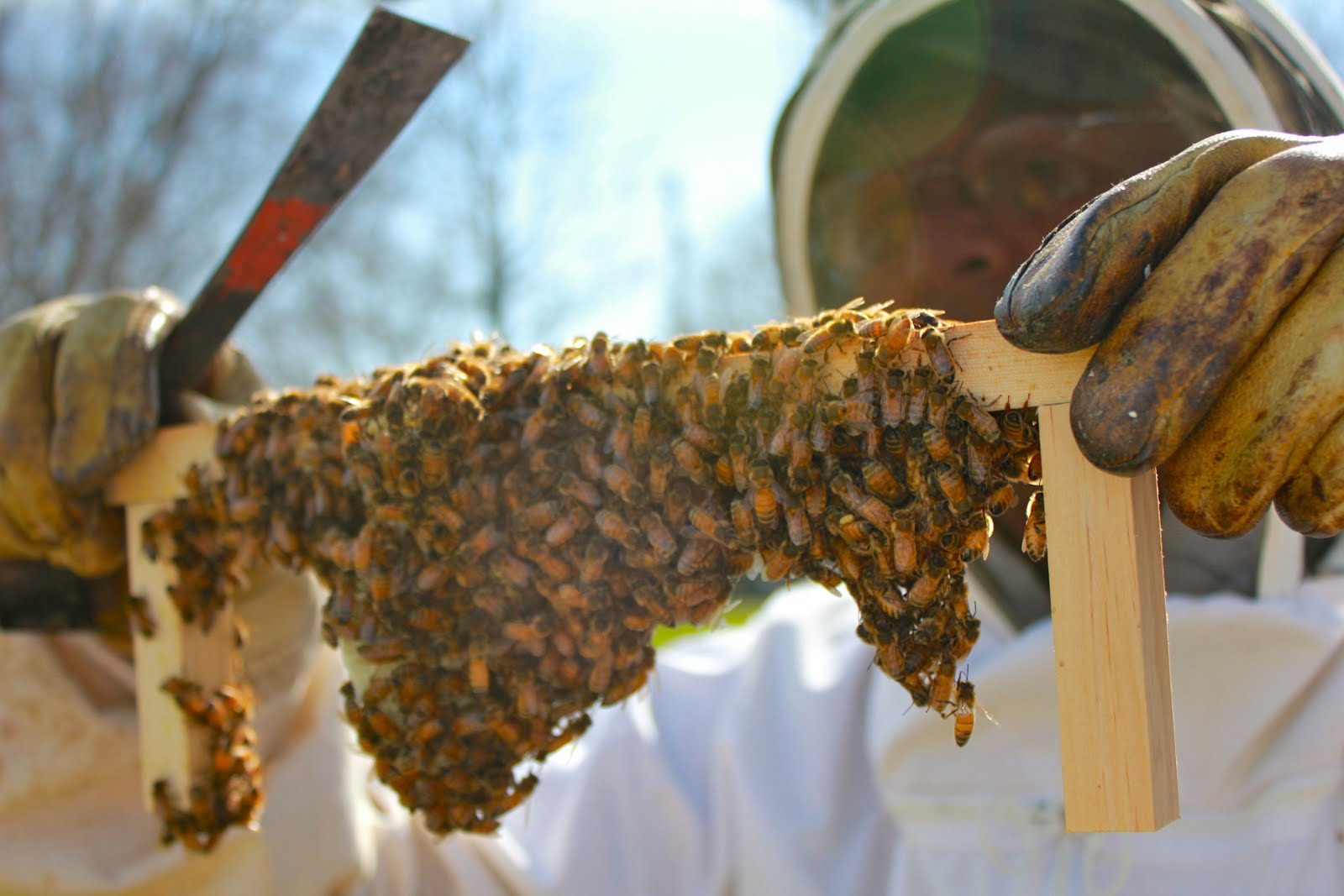
Tom held up a bar from my Warre hive where the bees were building comb in the swag-like shape they create in nature. He told me these drapes of bees are called "festoons."
We removed a few beginnings of comb that were not in the best areas of the hive for us, the beekeepers. The darker comb was built from recycled wax from an old frame of last year's hive. The lighter comb is brand new comb in one of my new Warre hives.
Such an amazing structure bees create!
We removed the little queen cage that we had hung between the bars. The queen cages were covered with loyal workers building comb from her cage and satisfying her every need.
Being very careful to not let the queen escape, we removed the cork from the opening and replaced it with a miniature marshmallow plug. We hung the queen cage back in the hive and made sure the bars were evenly spaced so the comb will be built in an orderly fashion. In a day or two, the queen and her attendants will have eaten her free and she can begin her life-long reign, laying eggs to build the hive.
Subscribe to:
Posts (Atom)