Showing posts with label Dairy. Show all posts

Tuesday, August 19, 2014

Painting the Milky Way!

We have a superabundance of fresh cows’ milk, thanks to generous LaFonda. Even though we are milk sharing with her calf (whom I estimate is drinking about 2 gallons per day) we are getting about 4 gallons a day, about 20% of which is cream. Our wonderful WWOOfer Lynette has dived into learning cheesemaking and is making about one small wheel a day - manchego, gouda, romano, parmesan, cheddar and more. (Here she is with two of the hard cheeses she waxed today.) Rog makes weekly mozzarealla and butter, and we enjoy lattes every morning, but we still have a lot of milk to use up. Overwhelming and stressful! But then I had a genius idea...
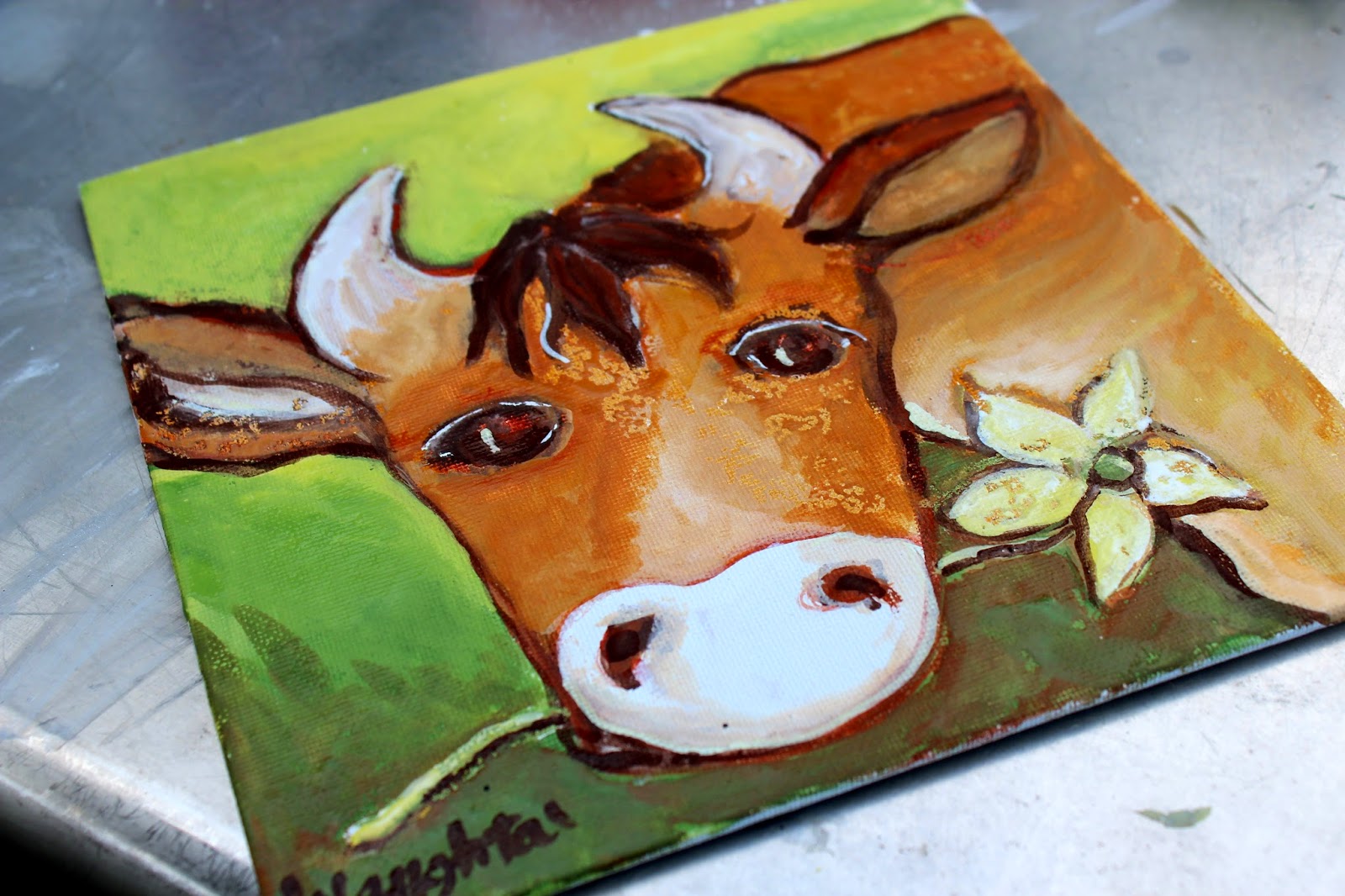
I am an artist, a painter, and can barely afford paints...my favorite  subjects to paint since becoming a farmer are cows and chickens...milk has been used since at least ancient Egyptian times to make paint...HEY, I should make paint from LaFonda’s milk!  What would be more appropriate than paintings of farm animals from my own cows' milk?

So, I have been doing research on making casein paint. Casein is the predominant protein in milk.  To make casein paint, you  start by making quark, a simple cheese like cottage cheese, made by souring the milk with vinegar.  Then you add hydrated lime, which turns it into a glue-like medium.  Finally, you add pigments and you have paint!
I ordered a sampler set of  French mineral pigments from  Earth Pigments. They told me  they didn’t have the lime, so I purchased it from a local masonry supply, but had to get a 50-pound bag ($8.99), however, when my pigment order arrived, a 6-oz bag of lime was included (for $2.99 - you do the math.) Yesterday while making other cheeses,  Lynette  combined the vinegar and fresh milk and set it in a warm spot to make the Quark for me.  Today it was successfully curds and whey,  The curds are the milk protein pat. I strained out the whey and rinsed the curds with cool water to wash out excess whey.
After  rinsing and draining the curds through three layers of cheesecloth, I dumped them into a bucket to make the paint medium.
I stirred the hydrated lime into the quark, and it immediately turned into a viscous, glue-like liquid. There were still a few small lumps of casein, which we strained through cheesecloth and achieved a perfectly smooth medium.
Tonight I made red ochre, yellow ochre, burnt sienna, titanium white and and pistachio green paints. I mixed equal parts of pigment powder and water to make a “slake”, then stirred the slake into the quark medium, and, Ta Dah! - we have paint!! It is like tempera paint- thin, opaque, matte.  The earthy colors are comparatively muted and it is not flexible, like the acrylic paints I am used to - it must be used on a hard surface, such as wood or canvas board.

I invited Lynette to paint with me. She reluctantly stopped weeding to make art.
We will have to learn the tricks of painting with casein paint. You can over-paint but it has to dry between payers - Lynette is blowing on the  paint to speed up drying.
Lynette’s first casein masterpiece.
My first casein painting - a little cow portrait. I am starting to get a feel for this kind of paint. It makes me very happy!!  The unused milk paint must be refrigerated and only lasts a couple days, so I will be forced to paint intensively (not a bad thing for a born procrastinator.)

Vendors cannot ordinarily sell artwork at the Rochester Downtown Farmers Market, but I will be permitted to sell these paintings because they are made from a farm product, our milk. I am curious to find out whether anyone will be interested in purchasing my art at the market!


Monday, August 18, 2014

Milking Lesson

First thing Sunday morning (before 7 a.m.!) Kristin and Lily arrived at the farm to learn to milk LaFonda. These two beauties are longtime friends of our daughter from high school rowing team days. Before they launched into chores and miking, they tied up their hair.
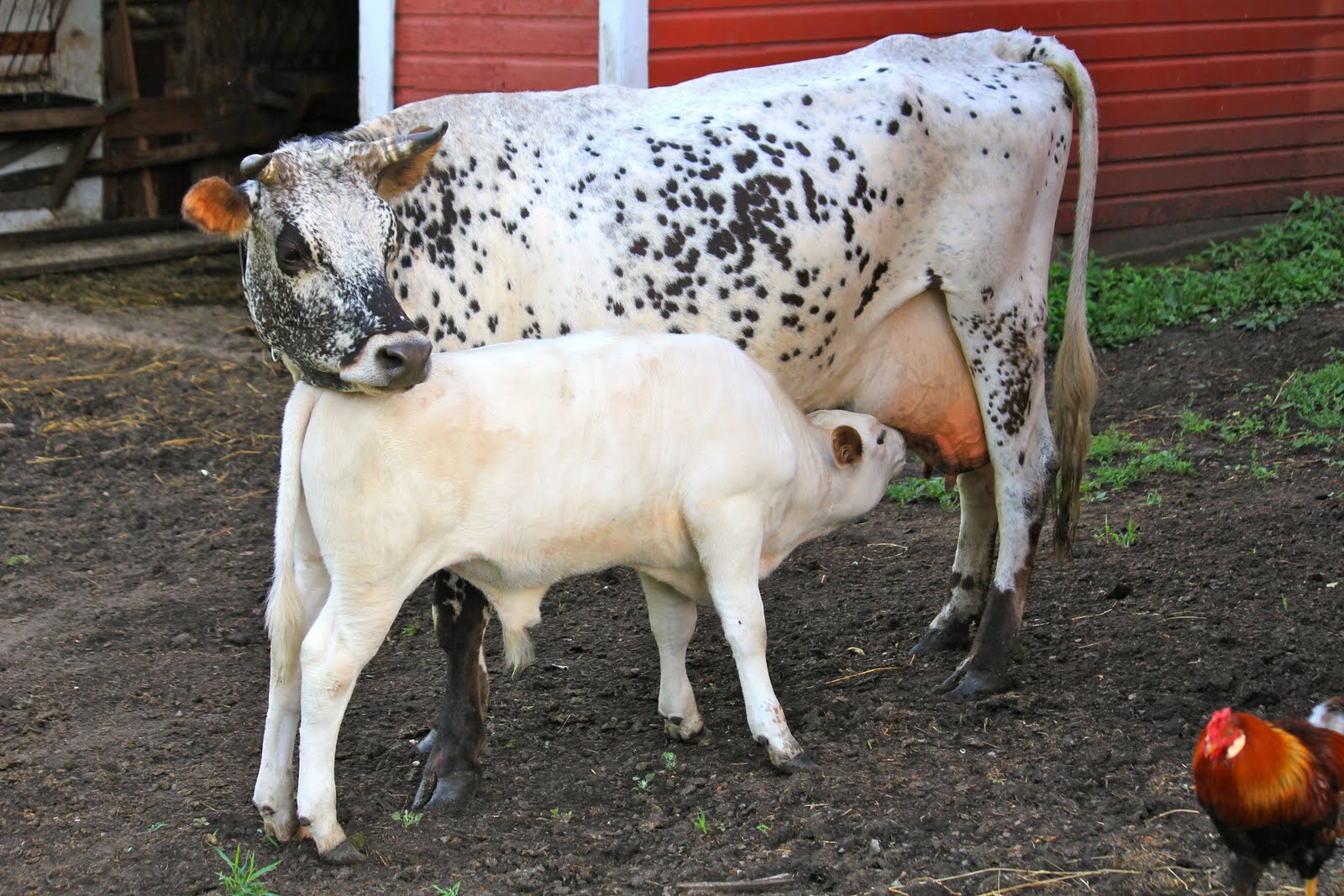
First we fed the chickens.  It’s part of the routine. When LaFonda sees me feeding the chickens she knows milking time is imminent and while I  take care of the poultry, she drinks water, lets Splotch drink his share of milk, and pees so she won’t have to do that in the milking parlor.
Everybody loves crazy Hobo.
I forgot to take photos during the actual milking session, but Kristin and Lily milked both by hand and using the bucket milker. LaFonda was totally calm and patient with them, and they were adept milkmaids.  After milking, they thanked LaFonda,  strained and chilled the milk, and cleaned and sanitized the equipment.
Afterward, we all relaxed on the patio, drinking cappuccino with fresh cream. Rog printed our instructions for making mozzarella and Kristin and Lily took home the morning’s milk for their next adventure, cheese-making. I can't wait to hear how it turned out!

Sunday, July 6, 2014

Pancakes for Breakfast

Rog made giant pancakes for breakfast this morning,
made with  LaFonda’s milk, farm eggs, garden raspberries, buttermilk from yesterday’s butter-making, served with farm butter and syrup made from our silver maple trees. YUM!

Monday, May 21, 2012

Monday

This morning got off to a sweet start.  Um, yes, I ate that piece of cake for breakfast.
It was leftover from the farewell cake we had at a little celebration yesterday for Julio, the percussionist in The Nodding Wild Onions.  Julio played with the band for the last time Sunday afternoon at the farm. He and his family are moving to Arizona. They will be missed!
Got milk? We sure do.  About 15 gallons at this moment. After I ate my breakfast cake, I tried to make space in the refrigerator for two more gallons of milk I had just collected from LaFonda.  In the process of shifting things around, a quart of cream leapt off the shelf and somehow managed to spill in every compartment of the fridge, including inside the veggie drawers, as well as all over the floor and under the  fridge. Aargh! Oh well, that  refrigerator was overdue for a good cleaning.
Today a few peonies were beginning to bloom!  I wish the Internet had a fragrance app so you could get a whiff of that wonderful peony aroma.
The ducks are getting so big and duck-shaped.  Our old female runner duck is starting to hang out with the ducklings sometimes now.
The gosling is starting to get feathers on his her/his wings. They are gray -- maybe s/he is a Toulouse.
The baby robins in the nest in my future garden shed are getting pretty crowded.  I don't mean to rush them, but I am very eager to get that shed finished.
The raspberry patch is loaded with blossoms and all the bushes are humming with a cloud of bees.  Mostly they are my honey bees, but there are also bumble bees and wild black bees that I think must be  carpenter bees.
I dragged the hose over to water the berry patches and was delighted to discover an abundance of strawberries already coming!  I have never had much luck with strawberries before, but this looks like it could be a successful crop. I better get some netting over them before they turn red so the birds don't get them all.


Tuesday, May 8, 2012

Milk Cow News

So, on Friday we inserted the weaning rings in the  calves muzzles so that we could dry off the moms. Their bodies need a break from producing milk before their new calves are born in July and time to produce colostrum. Colostrum is the first milk, full of antibodies to give the new calves protection from illness. Colostrum is so critical that newborn calves often  do not survive without it.

The weird thing was, LaFonda was behaving as if she were in heat.  I posted a question about it on the Family Milk Cow website. Two people responded that I needed to have a vet do a pregnancy check--she might have an ovarian cyst that caused pregnancy symptoms. Yesterday afternoon the vet came out and did the pregnancy check.

The good news is that LaFonda is healthy- no cyst.   The bad news is she isn't pregnant - there will be no calf in July. She probably aborted or reabsorbed the fetus a couple months ago. The good news is that her 1-year-old baby is being weaned, so now WE get all the milk!  

So, rather than drying her off, I have begin a milking morning and night. I hope to  reduce to once a day miking soon.  She is giving over 3 gallons - no wonder Lindy has become such a burly little fellow.  


The first few milking sessions did not go so smoothly. We both have to re-learn the routine. LaFonda wanted Lindy to have the milk, not me, so she was holding up her milk and kicking off the claw. I was frustrated and a bit afraid of being kicked, and I wanted to just give up, but it is imperative that she be emptied or she will get mastitis.
Finally, I resorted to purchasing a Kow Kant Kick. This metal, horseshoe-shaped tool  fits over the cow's back with the side bars nestled in front of her hip bones. The device is tightened down with a crank.
It doesn't cause discomfort, but the cow is unable to move her hind legs more than a little shuffle.  Amazing success!  She stood  calmly and quietly,  munching her  grain and hay.  After a few days I probably won't have to even use it any more, but it will be a great tool to have on hand if somebody new ever wants to milk her or if we ever want  to train a new cow for milking.
It has only been three days of dairying and already LaFonda is getting into the new routine, waiting for me at the door when it is milking time. She is the most wonderful cow.

Sunday, July 3, 2011

Milking Time

This morning LaFonda must have slept in.  She wasn't  quite ready to be milked at her usual milking time; Lindy was still nursing.
When he is nestled up to his mom drinking, it is really apparent how much he has grown!  He drinks a lot - our share of LaFonda's milk has dropped from almost 4 gallons a day to just one gallon a day--he drinks the rest.  I'm not complaining--one gallon a day is much easier to deal with than  four.
Before  we took LaFonda in to be milked, Bethany did a little calf-whispering. She and Brendan are befriending the calves, working toward halter-training them. They have have been helping me with the milking the past week, learning the process.  This morning Bethany did the entire milking session herself, with me hovering over her, poor girl.  She did great!
While Bethany  bonded with the other cows, LaFonda dealt with a little itch. So that's why the trim on the barn is broken! 

Tuesday, May 31, 2011

Morning Milking Routine


Milking has finally become a smooth and predictable routine!  As soon as she hears me turn on the vacuum pump to rinse the sanitizer out of the bucket, LaFonda ambles over to the barn door to be let in. She knows there is yummy grain in the stall and she heads right into her spot.  I tie her collar to the wall and her back leg to the post using dog leashes so she can't kick and will stay right where I want her. She gobbles her grain up very fast, so I layer it with hay in her dish and sprinkle it on the floor around her dish to slow her down and give me more time. The floor of the stall has pine bedding for easy clean-up, but happily, since the first stressful week of milking with the machine, she has not peed or pooped during milking.
First I wash her udder with warm soapy water.  This is for cleanliness, of course, but also to make sure her udder has no cuts or injuries and it triggers the milk letdown.  Next, I use a dairy wipe to wash each teat.
It is good practice to discard the first few squirts of milk in case there is any  bacteria in the teat canal. I hand-milk a few squirts fromeach teat into my palm, looking to make sure the milk appears normal (if it has any lumps it would indicate a mastitis infection.) A few times a week, I also squirt milk from each teat onto a mastitis indicator card.  LaFonda hasn't had any mastitis, but if one of the circles turned greenish, I would milk that quarter last and not mix it with the milk for human consumption because I do not want any bacteria in the milk.
Now I can milk. I attach the "claw" to her udder.  There are four "inflations," one for each teat, but I am only milking three quarters, as her calf is nursing from the left front quarter. (The third inflation, plugged, hangs down to the ground.)  My vacuum pump is very small with no vacuum tank, so I must attach each inflation one at a time. The first one is easy  - I hold the inflation up to her back left teat and  open the valve;  the  inflation jumps onto the teat and begins a pulsating vacuum that simulates a calf's sucking.  You can see the milk start to surge through the hose to the bucket.
The remaining inflations are plugged with blue plastic plugs.  To attach each one, I pinch off the inflation tube, remove the plug, hold it up next to the teat and unpinch the hose - hopefully it grabs onto the the teat and begins pumping (but if I do not  pinch off the tube well, I lose vacuum and everything falls off and I have to start over!)
It sounds easier than it is-- for me, the claw is like handling an octopus and has taken a significant measure of strategy and coordination to master.
I am constantly watching to make sure LaFonda isn't going to kick (the dog leash tie is helpful, but not fool-proof.) She never has kicked me, but if something is uncomfortable or she thinks she is done, she stomps her foot - and if I don't respond fast enough, she picks up her back foot and pushes the claw off. (I hate that because usually she has mud on her hoof and if the inflations fall on the ground they can suck up straw or pine shavings.) Once she did this when I was not paying attention and caught my wrist with her hoof- resulting in a lovely bruise.  Now I remember to pay attention.
I can tell she is nearly empty when the amount of milk flowing through decreases. When she is done, I remove the claw, hang it on the bucket and untie LaFonda while she finishes up the last bits of grain. I spray each teat with Fight Bac teat spray.  The opening in the teat does not totally close up until about 20 minutes after milking, so if she were to lie down in mud or manure,  bacteria could be introduced and she could get mastitis. The teat spray seals out the bacteria.
Those other products on the ledge are horse shampoo for a beauty bath I intend to give LaFonda one of these days, and Udder Comfort - an  herbal  lotion smelling of peppermint that I used to  cool and soothe her udder when she first calved and it was so swollen and tender.
LaFonda's part is now done - I brush her a bit,  thank her and let her out into the pasture with the rest of the herd.
This morning's frothy, creamy two gallons in the bucket milker.
Normally I  pour the milk through a fine sieve into 2-gallon jars or 1-gallon pitchers, but today I used a big pot because I am making yogurt.
The sieve catches any material that might have gotten into the milk. Filtering was critical when we hand-milked and inevitably a few cow hairs or specks of dirt fell into the open bucket, but now there is rarely any contaminant.   I love the bucket milker for saving my poor aching hands and I also love that it is a closed, sanitary system. The milk goes into a tub of  ice-cold water in the kitchen sink to be chilled before being sealed up and put into the refrigerator.
I don't love so much the clean-up aspect - not because it is hard, but because I have to haul heavy buckets of very hot water from the house.  The first bucket has a bit of dishwasher detergent. I take the gasket out of the lid and wash it, wash the blue inflation  plugs, and scrub out the inside of the inflations with the niftiest brush designed for the task. Then I turn on the vacuum pump and run all the hot, soapy water through the system, cleaning out the  hoses and the claw. I dump that water out and repeat with the second bucket, which contains dairy & food sanitizer in the hot water. You are supposed to be able to let the sanitizer dry on the surface without rinsing, but I always run pure hot water through the system prior to the next milking to avoid any trace chemicals in the milk bucket.

Another flawless milking session completed!


Monday, May 9, 2011

Milkhouse Blues

Last week was thrilling, with a new calf and 3 beehives, but overwhelming and exhausting too, with Rog out of town all week and me dealing with the #@* bucket milker.  I am basically a glass-half-full kind of person, but lest you think life on the farm is always simple and placid, and before I erase  them from my memory, today I will write about last week's trials and tribulations, which mostly center around cow-milking.

LaFonda's udder is huge and she produces much more milk than her calf can drink. Dairy cows have been bred to produce lots of milk, and it has to come out or the cow will be in misery and get mastitis. The first few days, she produces colostrum instead of milk, very rich and full of antibodies that are vital for the calf's health. (My beekeeper friend Tom told me that in Scandinavian countries  they make colostrum pudding, but, um,  I didn't try  that.) It is always recommended that you freeze colostrum for a future calf emergency, which I did, although our next calf is at least two years in our future.

Last summer we hand- milked LaFonda, with Cadence handling the morning milking, and I did the evening.  My hands never did adapt - they cramped up in agony after just a few minutes, so I had to alternate hands and milking poor, patient LaFonda took me forever. I thought a bucket milker would be much easier.  Ha! There have been so many challenges:

  1. My bucket milking system is assembled from old, donated & refurbished components (my frugal nature).  While this may have saved me a few hundred dollars, they do not add up to the ideal system. The cover does not fit as snugly on the bucket (this brand is no longer made) as it should - risking losing the vacuum easily -and the pump itself is just barely sized  big enough.
  2. LaFonda has never been machine-milked before, her udder is very swollen and sore, and right after giving  birth cows can have crazy hormones.  I had accustomed her to the noise of the pump - that does not seem to bother her. But the moment the inflation latched onto her teat, she turned into a kicking, bucking bronco.  She has some pretty fancy kicks - sideways with her back legs and  backwards with her front legs. She is normally a gentle soul  and has never kicked me before.  I was so nervous about the possibility of being kicked or knocked over (especially with Rog gone and nobody to rescue me if I got hurt) that I am sure she could sense my fear and it made her more scared. 
  3. Out of desperation, I called in support. Nancy and Angie, from the dairy farm across the road and Marv the equipment dealer tried to help the first night (we got a little milk, but it was scary.) It was especially stressful for LaFonda, having all those strangers crowded in the stall with us. So, the next day I hand-milked for most of the morning and realized, hands throbbing, I simply cannot hand milk. I am so slow, I would have to do it continally, all day long.  
  4. On the verge of tears I called up my veterinarian and asked if they knew anybody whom I could hire to assist/coach me. They sent out their son, Robert, a strong, young man who happened to be visiting home and works with zoo and farm animals - I was so grateful. Even with Robert's fearlessness and strength, it was a challenge to milk LaFonda.  We tied her back leg and Robert held her tail straight up so she couldn't kick. I felt terrible because I know LaFonda hated every moment, and milking time used to be so pleasant.  Robert  came back that evening, and it went a bit better. At least LaFonda was beginning to understand that the machine wasn't going to hurt her. She still flinched and stomped when I attached it, however. 
  5. I was apprehensive the next morning when I had to milk unassisted. It really bothered me how she jumped when I attached the inflations.  Also, attaching all four inflations of the claw is tricky - especially if you are distracted watching to avoid being kicked.  So, I tried turning the vacuum down and I decided to milk just one quarter at a time.  I plugged three inflations and attached just one. She barely flinched! The vacuum must have been set too strong for my delicate cow.
  6. That evening Robert returned with a Cow Can't Kick  that the vet offered to  lend me. It is a big metal U-shaped contraption with a crank in the  middle. You slip it over the cow's back and tighten it in front of her hip bones just enough that she can't kick or move around much. I hope I won't need to use it forever, but for now, it makes me feel much more at ease until LaFonda and I get our routine down. I hope after a few calm, gentle sessions,  she will have a better association with the process.

Right now I am milking three times a day; three times a day I get a big adrenalin rush.  I will only have to milk this often for a few weeks until the rapidly-growing calf is drinking more, then I will reduce to twice a day, and ultimately, once a day.  Right now it feels like all I am doing is milking cows, cleaning up the miking equipment, and dealing with the milk! Yesterday, I made a gallon of yogurt and 2 quarts of kefir. Today...maybe ice cream?

I intended to take a photo of LaFonda in her Cow Can't Kick and the bucket milker set up for this post, but as I was carrying the bucket of hot water for udder-washing in one hand and the grain bucket in the other hand, my new camera slung over my shoulder, it slipped off --landing in the water bucket.  I was  totally dismayed--my camera lens was full of droplets of moisture.  Miraculously, last night it seemed to have recovered. Whew - I am lost without my camera.

Instead, here are a couple clips of letting the cows into the grassy the upper pasture for the first time:

When Lariat noticed her reflection in the big windows on the barn, she got very upset about that other cow!

LaFonda feasted.


Tuesday, May 3, 2011

In Training for Milking

The vacuum pump arrived for the bucket milker and over the weekend Rog and I got it hooked up in the barn. I don't know if LaFonda has ever been milked by a machine before (the people we got her from acquired her at a livestock auction), so I decided to  get her into the routine of coming into the barn morning and night for her ration of grain and accustomed to the noise of the milker.  Sunday morning,  LaFonda came inside happily, just like the good old days last summer when we were hand-milking, and did not flinch when I turned on the loud vacuum pump.

Sunday evening, when I went out to  do the chores LaFonda was already waiting for me at the barn door, peering in.  She seems quite eager to get back into the miking routine.
The kind farmer I get hay from gave me an old bucket milker that had been in his attic for 30 years.  It was bafffling and challenging to figure out and find all the parts I needed - until I  located Marv, a dairy equipment rep. He helped me select a vacuum pump and new pulsator and refurbished the  "claw" - the octopus-like contraption that attaches to the cow's udder. This morning he stopped by to show me how it all works, adjust the vacuum level and showed me how to clean it easily. I feel fairly ready now.
LaFonda must  feel very ready. Her udder is so large now that she has to walk with her back legs awkwardly stretched apart to straddle it.  She seems enormous to me - especially for a cow that was bred with a mini cow so she would have a small calf.  Tonight our dairy farmer neighbor stopped by and I wondered if it is be possible she has twins. Mark responded, " I was thinking the same thing." He said he could be wrong, but now my worry level has elevated considerably.  Twin calves are much more likely to have problem births, with one of the pair being born in the wrong position -- a medical emergency.

I am going to be keeping a very close eye on her.

Sunday, May 1, 2011

Progress of the Projects

We are of the belief that spring is coming, despite evidence to the contrary. The unrelenting rain and wind and gloominess  makes it a challenge to get outdoor stuff done, but we are making progress, especially on the inside projects. The granary, which  will open as our little farm store in a few short weeks, is really shaping up!
Rog trimmed  all the windows, I painted the dry-walled areas, and Rog installed a masonry half wall behind the wood stove to make it fireproof, more beautiful and to hold the heat.
The electrician finished wiring the granary and installing the  track lighting and the huge ceiling fan. Nearly all the materials used to renovate this building are recycled or repurposed - with the exception of the ceiling fan and lights.
It cleared off enough  on Friday afternoon for me to set up our little greenhouse, although getting the  covering pulled on was quite a trick in the wind!  I have been wondering whether it is even worth setting up, I am so late, but this morning was only 34 degrees, so still too cold to put plants out in the garden.
I moved a few plant starts into the greenhouse - these are ornamental gourds (Birdhouse, Basket, Snake and Swan) that I hope to grow for gourd art.  I hope it is warm enough for them in the  unheated greenhouse in this crazy weather.
The other accomplishment I am most happy about is turning the stall in the barn into a milking parlor. Although I loved the rustic character of the 100-year-old barn walls, it was dark and inevitably  dusty miking in the old stall.
We lined the walls with glassboard mounted on MDF board -much easier said than done. Nothing is square in this old barn and the MDF board must have swelled  in this humidity - It was tricky to work with. If you don't look too closely at our carpentry, it looks wonderful.  The walls will be easy to  wipe clean and the pristine white looks so sanitary, as a dairy should. Maybe it's a bit too sterile-  this milking parlor needs some colorful cow art on the wall.
It was a race to get the milking area finished before LaFonda had her calf and we have to start milking her. As of this morning, no calf- we made it.

This unflattering of LaFonda photo taken yesterday  shows how gigantic her udder is now- with her huge calf-filled belly, lying down is very awkward. But standing and walking are also cumbersome. She never complains, but she seems pretty uncomfortable-- I hope this calf comes SOON!