Friday, May 6, 2011

Dancing with Cows


The calves finally have names!
"Lindyhop" is the white bull calf.
 "Jitterbug" is the Dexter heifer.

They are still mostly eating and sleeping, with brief spurts of frolicking, but I know that soon there will be joyous scenes of calves dancing across the pasture.
"I could dance with you till the cows come home.
On second thought
I'd rather dance with the cows till you come home."
                                              Groucho Marx

Thursday, May 5, 2011

Bee Happy

We got our bees installed with perfect timing--it was  perhaps our first two-day stretch of warm sunny weather this year. Yesterday, the dandelions  burst into bloom, and the honeybees were already visiting them. You can see packets of pollen on this bee's back legs. Pollen is high in protein and the bees use it to feed their brood.
Although we weren't planning to do this for a couple days yet, Tom called and said the bees we installed just the day before were already building comb like crazy and he thought we should get ready to release the  queens.
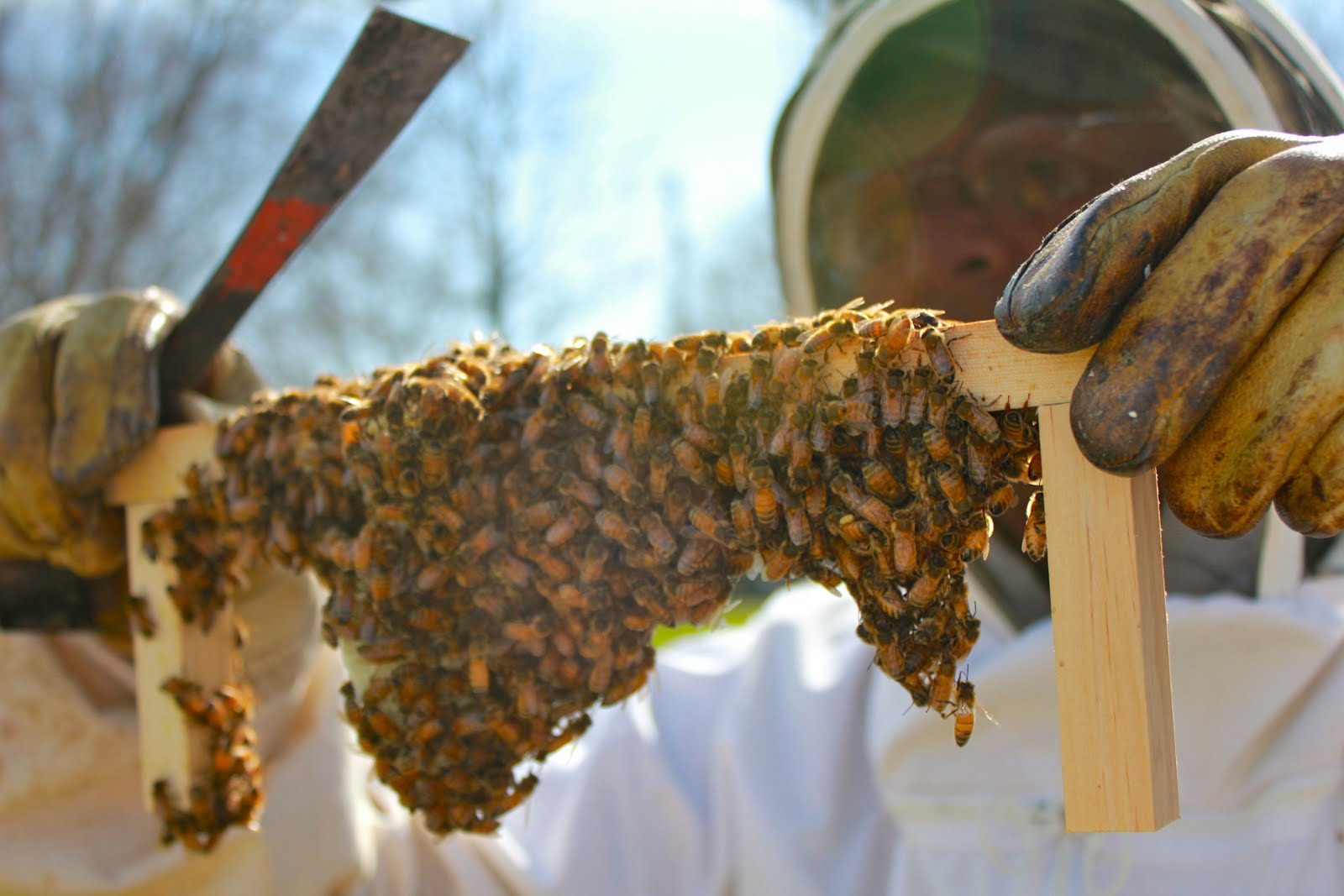
Tom held up a bar from my Warre hive where the bees were building comb in the swag-like shape they create in nature. He told me these drapes of bees are called "festoons."
We removed a few beginnings of comb that were not in the best areas of the hive for us, the beekeepers. The darker comb was built from recycled wax from an old frame of last year's hive. The lighter  comb is brand new comb in one of my new Warre hives.
Such an amazing structure bees  create!
We removed the little queen cage that we had hung between the bars. The queen cages were covered with loyal workers building comb from her cage and satisfying her every need.
Being very careful to not let the queen escape, we removed the cork from the opening and  replaced it with a miniature marshmallow plug. We hung the queen cage back in the hive and made sure the bars were evenly spaced so the comb will be built in an orderly fashion. In a day or two, the queen and her attendants will have eaten her free and she can begin her life-long  reign, laying eggs to build the hive. 

Wednesday, May 4, 2011

Newest Member of the Herd

An exciting day--today LaFonda's calf was born.  I had a feeling today would be the day, because although she ate  her morning grain, LaFonda seemed much less enthusiastic about it than usual. Then, an hour or so later I found her with standing with her tail held up in a funny way - that's a sign. I saw her water break about noon, but she kept standing up, not lying down so labor could progress. I was afraid I was distracting her so I left for ten minutes and when I returned, she was already licking her  muddy, wet calf clean.
He's a little bull calf. I got to watch him stand on his  wobbly legs.
He is pretty big - about 60 pounds, with long legs.
 He is totally white except for his brown ears and muzzle. In appearance he takes after his father's side of the family; his sire is a British White Park, but he is big like his mom.  I hope he is naturally polled (hornless) like his father so we don't have to decide about dehorning him, and I hope he inherits his mother's patient, gentle nature.
Lariat  also checked him over.
He is so darn cute! I had a trying 3-hour session of attempting to milk LaFonda with my new bucket milker tonight.  That is a story for another post, but I am sure the entertaining antics of these delightful calves all summer will make it worth all the frustrations!

Our herd.


45,000 New Head of Livestock!

I discovered that my neighbor Tom Bramble is a professional beekeeper and was delighted when he agreed to be my bee mentor this summer.  Tom offered to pick up my new bees when he picked up his - perfect because they were expected to arrive on LaFonda's due date,  next Saturday.

But then Tom called Sunday night and said they had arrived earlier than expected and he would  have them to me on Tuesday at noon. I was not ready!  I still had to paint the new hives - which I did until midnight in the dining room.
My  old hive,  a Langstroth hive, has rectangular frames surrounding a wax honeycomb foundation that the bees build comb upon in a uniform structure, very convenient for the beekeeper.
My new hives are Warre hives, and instead of frames, they have bars with two legs that hang down across the top of the boxes. The bees construct their natural sling-like comb. It's messier for the beekeeper to deal with, but the theory is that the bees can customize cell size for worker bees or drones and make smaller-sized cells that  discourage  the  dreaded Varroa mite.
Each bar requires a bead of  beeswax centered along the bottom edge to lure the bees to build where you want them to. Tom had cut slits along the bar where he poured melted wax- but my bars didn't have slits. We invented a solution -  which could be genius or folly, we'll see.  I used a hot glue gun to draw a bead  along each bar...
then painted over the bead with melted beeswax. Hopefully the bees will find that to be an irresistibly convenient foundation.
Yesterday morning, I sited the hives.  The main reasons I decided to try Warre hives are that 1) they are  supposed to be lower-maintenance and 2) the boxes are much smaller and easier to handle (Langstroth boxes are HEAVY when full of wax, honey and bees.)  However, I have to admit, 3) I also was drawn to them aesthetically - they are just so cute!  I sited the new Warre hives along the north edge of our yard where they will get warm sunshine, a bit of midday shade, shelter from wind, and can be admired from my dining room window.  The old Lansgstroth hive was moved from the pasture  to a spot  between the two flowering crabapple trees -this will be a prima spot in a week or two when those trees bloom.
Tom and Sister Alice,the beekeeper at Assisi Heights, arrived with the three packages of bees and stayed to help me install them.  Between them, they must have well over 50 years beekeeping expertise, so I couldn't have dreamed of better assistance! We closed up the entrances and  poured the package of bees into the hive. We spritzed the bees with a sugar water solution, which reduces their flying ability and keeps them distracted,  licking the sweetness from each other.

The queen is in her chamber - a little cage that protects her until the bees are settled and have accepted her as their queen. It takes a few days for her queenly hormones to kick in, and before then, her subjects would likely kill her.
Her cage is hanging on a bar inside the  hive - I will let her out in three days.
Each 3-pound package contains approximately 15,000 bees.  With three hives, we now have 45,000 new head of livestock on our farm (bees are officially considered to be livestock.)

The top box of the Warre hives  has a feeding area, in which we placed comb full of honey from last year's hive to nourish the bees until the dandelions and creeping charlie start blooming (any day now!)
With the help of my two lovely assistants, the installation of the three hives took less than an hour.  The bees seemed to be settling in pretty well, so we relaxed with a glass of limeade on the patio before Tom and Sister Alice left to install Tom's final four packages.

It was pretty hectic getting these bees installed yesterday, but it was a rare  sunny, warm day - making all the beekeepers and bees very happy.  I am glad they arrived early - and relieved they did not arrive at the same time as my expected calf.

I just looked out my dining room window and can see that already this morning the bees are getting to work. All seems right with the world.

Bonus auditory treat: When I was researching Warre hives I became acquainted with a beekeeper in Maine, The Luddite, who writes engagingly about her apiary. Her husband is a composer who incorporated recordings of her bees into a lovely, jazzy piece of music: "Chant Des Abbeilles."(scroll down his page to listen.)


.

Tuesday, May 3, 2011

In Training for Milking

The vacuum pump arrived for the bucket milker and over the weekend Rog and I got it hooked up in the barn. I don't know if LaFonda has ever been milked by a machine before (the people we got her from acquired her at a livestock auction), so I decided to  get her into the routine of coming into the barn morning and night for her ration of grain and accustomed to the noise of the milker.  Sunday morning,  LaFonda came inside happily, just like the good old days last summer when we were hand-milking, and did not flinch when I turned on the loud vacuum pump.

Sunday evening, when I went out to  do the chores LaFonda was already waiting for me at the barn door, peering in.  She seems quite eager to get back into the miking routine.
The kind farmer I get hay from gave me an old bucket milker that had been in his attic for 30 years.  It was bafffling and challenging to figure out and find all the parts I needed - until I  located Marv, a dairy equipment rep. He helped me select a vacuum pump and new pulsator and refurbished the  "claw" - the octopus-like contraption that attaches to the cow's udder. This morning he stopped by to show me how it all works, adjust the vacuum level and showed me how to clean it easily. I feel fairly ready now.
LaFonda must  feel very ready. Her udder is so large now that she has to walk with her back legs awkwardly stretched apart to straddle it.  She seems enormous to me - especially for a cow that was bred with a mini cow so she would have a small calf.  Tonight our dairy farmer neighbor stopped by and I wondered if it is be possible she has twins. Mark responded, " I was thinking the same thing." He said he could be wrong, but now my worry level has elevated considerably.  Twin calves are much more likely to have problem births, with one of the pair being born in the wrong position -- a medical emergency.

I am going to be keeping a very close eye on her.

First Toad of 2011

When I was  replacing the bricks from around the access to our septic system, I unearthed this  toad, nestled under a brick. Poor  fellow, he had to endure being carried around in my hand for half an hour while I searched for  my camera, which I had forgotten I had tucked on a ledge in the barn. After he was immortalized him in a photo, I placed him next to the bricks so he could dig underneath again if  he desired. I made sure no chickens saw  him -- last summer, I learned the heartbreaking way that chickens like to devour toads as much as they like mice.

Monday, May 2, 2011

Bird Bait

Yesterday my beekeeping friend Sue posted on FB that she had seen an oriole in her yard. Today, another beekeeping friend, Joe, noted that his hummingbirds were back.

I haven't seen either orioles or hummers yet, and it seems too cold for them (my gourd starts in the little greenhouse froze last night!) but I put out feeders today. If they do show up in this chilly weather  they surely will appreciate some calories.

It's not very fancy, but I drove a long skinny nail into a couple of my fenceposts and stuck half an orange on each. If there is an oriole around, I know he won't be able to resist  an orange.

We've been hearing the White-Throated Sparrows and  Rose-Breasted Grosbeak the past few days.  If you play these two videos simultaneously with the Red-Winged Blackbird and the Robin, (and you add an occasional chicken and cow) it sounds just like our yard. I love seeing these springtime birds, even though many are only passing through.

In other news, still no calf from LaFonda...